My research involves star formation in various different contexts, I currently have 3 projects I am working on, with another on the way, all related to star formation, here is a one minute description of each project in reverse chronological order from when the project began!
1. The Limitations of Radio Continuum as a Star Formation Tracer
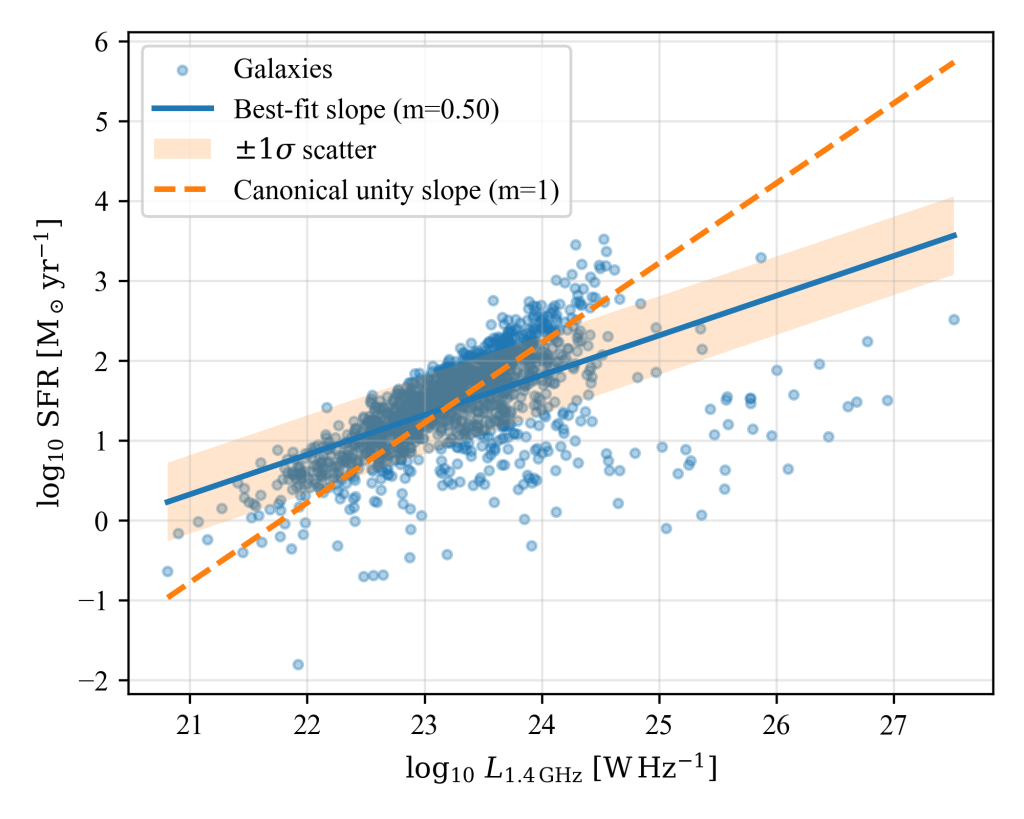
For decades, we as astronomers have employed the use of 1.4GHz radio continuum emission as a star formation tracer; we have justified this through the interpretations of certain physical phenomena, namely the the FIR–radio correlation (FRC), which is established in the local universe. The FRC links thermal dust emission powered by young stars with synchrotron radiation from cosmic-ray electrons accelerated in supernova remnants, implying that both processes originate from the same population of massive stars (≳8 M⊙). There are issues with this line of thinking however, Fundamentally, the radio continuum emission in star-forming galaxies arises primarily from non-thermal synchrotron radiation, produced by cosmic-ray electrons accelerated in supernova remnants, and to a lesser extent from thermal free-free emission associated with H ii regions. In this work, we investigate the validity of the commonly assumed linear correlation between 1.4GHz radio luminosity (RL) and infrared derived star formation rates (IR SFRs) using machine learning (ML) techniques trained on data from the VLA-COSMOS 3 GHz Large Project. We apply these models to 24 galaxy cluster fields drawn from the MeerKAT Galaxy Cluster Legacy Survey (MGCLS), and to the VLA-COSMOS 3 GHz field, spanning a range of environments and morphologies. Our results reveal that, contrary to the canonical FRC,
there is no intrinsic linear relationship between RL and SFR in any of our populations; this agrees with recent research conducted via SED fitting. We find that this disconnect holds across diverse galactic morphologies and environments, including field galaxies and cluster members, suggesting a fundamental limitation of RL as a tracer of
star formation activity.
2. Uncovering a hidden population of obscured AGN in JWST data
Observational evidence suggests that a large proportion (perhaps
the majority) of active galactic nuclei (AGN) in the local Universe
are obscured by Compton-Thick (CT) gas, with the fraction only
increasing at higher redshifts! However, many of these are hidden from our view because the light they emit across many wavelengths is either hidden from us due to dust-obscuration in the host-galaxy, or due to the technological limitations of our telescopes, however, JWST helps us in this case.
A population of ‘mildly’ Compton thick sources (where the column density ≤ 1025cm-2) is postulated in AGN synthesis models. The high wavelength emission from the AGN is absorbed by the dust, and is eventually re-emitted in the infrared (IR), making Compton thick sources potential contributors to the long wavelength background. This re-emitted IR emission is also what allows us to uncover a new population of highly-obscured AGN candidates. We use a visual machine learning classifier called Zoobot to identify these candidates, and to aid us in uncovering a hidden population of CT AGN candidates in JWST NIRCam imagery.

3. Gas stability in nearby elliptical galaxies observed by ALMA
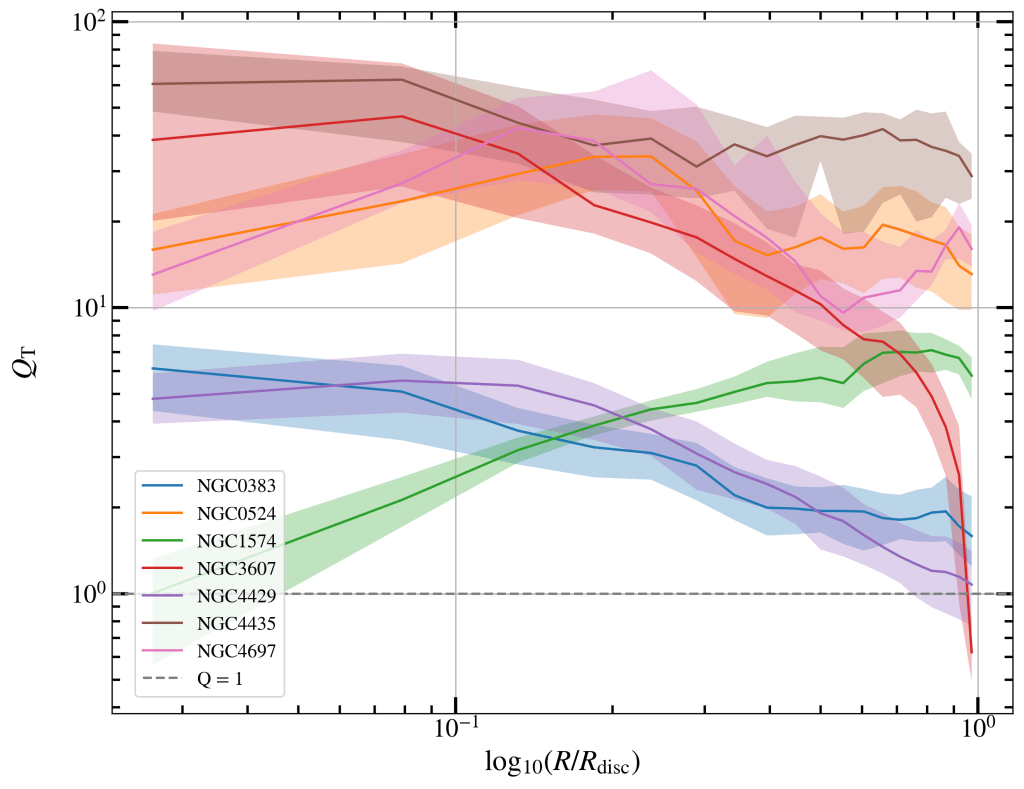
Around 1/4 of quiescent, elliptical, galaxies are rich in cold molecular gas, quiescent to the extent that they are sometimes referred to as ‘red and dead galaxies’; this is puzzling because cold molecular gas in principle is the ideal ingredient for star formation to happen, yet we don’t see it happening. Combining ALMA observations of CO, and models of stellar mass distributions, we investigate the large-scale dynamical stability of gaseous disks in 7 nearby elliptical galaxies, and we show that the Toomre Q parameter is an effective threshold to use when gauging the likelihood of molecular cloud fragmentation, and subsequently star-formation to occur.
 J.S.Makechemu